Insurance Solutions in the Gulf Region
The Gulf Cooperation Council (GCC) region, encompassing Saudi Arabia, United Arab Emirates, Qatar, Kuwait, Oman, and Bahrain, has developed a sophisticated and regulated insurance sector essential for economic stability and personal security. Insurance in the Gulf serves as a critical financial safety net for millions of residents and businesses, offering protection against unforeseen circumstances in a rapidly developing economic environment. With diverse offerings tailored to regional needs, understanding available insurance options ensures you make informed decisions for your assets, health, and future.
Health Insurance: A Mandatory Protection
In most Gulf countries, health insurance is now mandatory for residents. Comprehensive health policies cover hospitalization, specialist consultations, medications, and emergency treatments. These plans vary from basic essential coverage to premium packages offering access to extensive hospital networks and international treatment options. Having adequate health insurance is not just a legal requirement but a crucial step in safeguarding your family’s wellbeing against high medical costs.
Motor Insurance: On the Road Security
Third-party liability motor insurance is legally required for all vehicles in GCC nations, covering damages you might cause to others. Comprehensive motor insurance extends this protection to cover your own vehicle against accidents, theft, fire, and natural disasters common to the regional climate. Given the high vehicle usage in Gulf countries, appropriate auto coverage provides essential financial protection and peace of mind on the region’s roads.
Property Insurance: Safeguarding Your Assets
Property insurance protects residential and commercial properties against fire, water damage, natural disasters, and other perils. In coastal Gulf regions, this often includes specific coverage for climatic conditions. For homeowners, mortgage lenders frequently require building insurance, while contents insurance protects personal belongings within. For businesses, property coverage is fundamental to risk management strategies.
Life Insurance and Financial Security
While cultural factors historically influenced life insurance adoption, the market has grown significantly in the Gulf. Life insurance products now provide financial security for families, with options including term life, whole life, and investment-linked plans. These products help secure your family’s future, cover outstanding debts, and can serve as long-term savings instruments in a tax-efficient manner.
Business and Commercial Coverage
Gulf businesses require specialized insurance products including liability coverage, employee protection plans, marine cargo insurance for import-export operations, and engineering insurance for construction projects. The region’s thriving commercial sector makes business interruption insurance particularly valuable, protecting against income loss following unforeseen disruptions.
Choosing the Right Insurance Provider in the GCC
Selecting an insurance provider in the Gulf requires careful consideration of several factors. Look for companies licensed by local regulatory authorities like the UAE Insurance Authority, Saudi Arabian Monetary Authority (SAMA), or other GCC regulatory bodies. Evaluate their financial stability, claim settlement reputation, customer service responsiveness, and network of hospitals or repair centers. Comparing policy features, exclusions, and premiums from multiple providers ensures you obtain optimal coverage that matches your specific needs and budget.
The Claims Process: What to Expect
When filing an insurance claim in GCC countries, promptly notify your insurer with all relevant details and documentation. For motor claims, police reports are typically required for accidents. Health insurance claims often involve direct billing arrangements with medical providers. Understanding your policy’s claim procedure, documentation requirements, and timeframes helps ensure a smooth settlement process during stressful situations.
Regulatory Framework and Consumer Protection
The insurance sector in the Gulf operates under robust regulatory frameworks designed to protect consumers. Regulations mandate transparency in policy wordings, fair claims handling, and adequate capitalization of insurance companies. Consumers have access to arbitration channels and insurance authorities for dispute resolution. Staying informed about your rights and responsibilities as a policyholder enhances your insurance experience in the region.
Future Trends in Gulf Insurance
The Gulf insurance sector is embracing digital transformation with increased online policy purchase, claims submission via mobile applications, and usage-based insurance models. Insurtech innovations are personalizing products while improving accessibility. Sustainability considerations and climate-related coverage are also gaining prominence. Staying aware of these developments helps you leverage new products and services as they emerge.
Making Informed Insurance Decisions
Adequate insurance coverage forms the foundation of sound financial planning in the Gulf region. By assessing your personal circumstances, business needs, and risk exposure, you can select appropriate protection for what matters most. Regularly review your policies to ensure they keep pace with life changes, asset acquisitions, and evolving regulatory requirements. Consulting with licensed insurance advisors can provide personalized guidance tailored to your unique situation in the Gulf’s dynamic environment.
Health Insurance for Workers in the Gulf
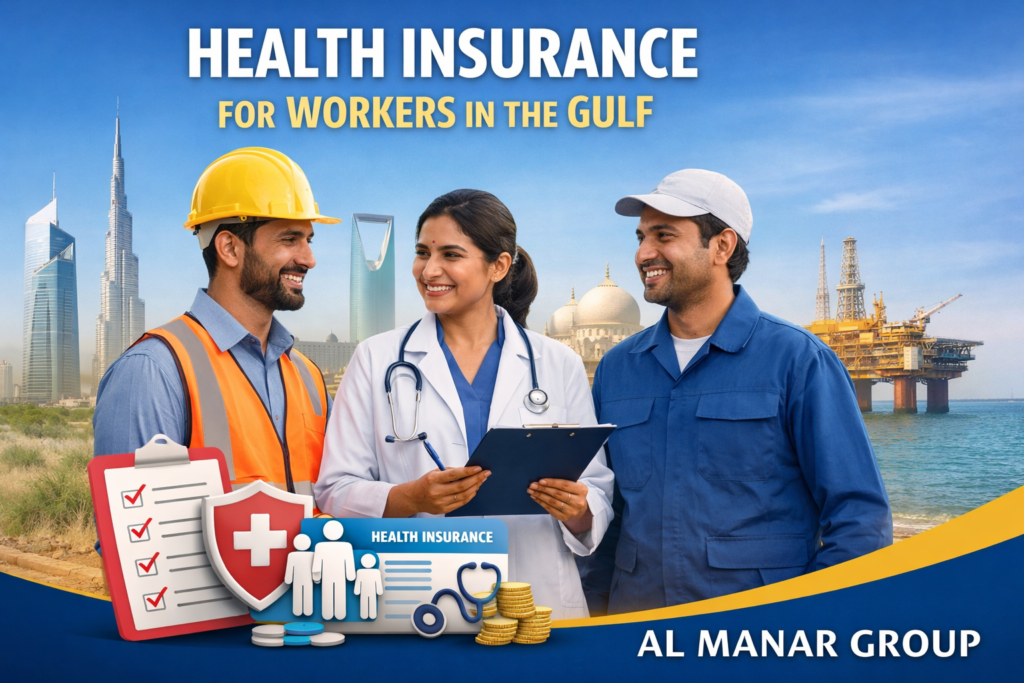
Health insurance is one of the most important benefits for workers in Gulf Cooperation Council (GCC) countries. Millions of expatriates move to Gulf nations every year for employment, and access to quality healthcare is a major concern for them and their families. To ensure worker welfare, most Gulf countries have made health insurance mandatory for employees.
In this detailed guide, we will explain everything you need to know about health insurance for workers in the Gulf, including coverage, rules, country-wise systems, benefits, costs, employer responsibilities, and common mistakes workers should avoid. This article is written in simple language to help both new and experienced Gulf workers understand their rights clearly.
Why Health Insurance Is Important for Gulf Workers
Healthcare in Gulf countries is modern and high quality, but it can be expensive without insurance. A simple hospital visit, medical test, or emergency treatment can cost thousands of dirhams or riyals. Health insurance protects workers from these unexpected expenses and ensures they receive timely medical care.
For expatriate workers, health insurance is not just a benefit but often a legal requirement. Without valid health coverage, workers may face fines, visa issues, or limited access to healthcare facilities.
Is Health Insurance Mandatory in Gulf Countries?
Yes, health insurance is mandatory in most Gulf countries, though the rules and coverage vary by nation. Governments introduced compulsory health insurance laws to protect workers and reduce pressure on public healthcare systems.
In many GCC countries, employers are legally responsible for providing health insurance to their employees. Some countries also require coverage for workers’ dependents, while others leave that responsibility to the employee.
Countries Included in the Gulf Cooperation Council (GCC)
The GCC includes six countries:
- United Arab Emirates (UAE)
- Saudi Arabia
- Qatar
- Kuwait
- Oman
- Bahrain
Each of these countries has its own health insurance framework, which we will explain in detail below.
Health Insurance for Workers in the UAE
The United Arab Emirates has one of the most structured health insurance systems in the Gulf.
In Dubai and Abu Dhabi, health insurance is mandatory for all employees. Employers must provide at least a basic health insurance plan for their workers. Without insurance, a residence visa cannot be issued or renewed.
Basic plans typically cover:
- Doctor consultations
- Emergency treatment
- Hospitalization
- Prescribed medicines
- Maternity care (limited)
For low-income workers, employers usually provide Essential Benefits Plans (EBP), which meet government standards at an affordable cost.
In other emirates, employers are strongly encouraged to provide insurance, and many already do.
Health Insurance for Workers in Saudi Arabia
Saudi Arabia has a compulsory health insurance system under the Council of Cooperative Health Insurance (CCHI).
All private sector employees, including expatriates, must be insured by their employer. Health insurance is linked to the Iqama (residence permit), and without it, legal residency is not possible.
Coverage generally includes:
- Outpatient and inpatient services
- Emergency care
- Diagnostic tests
- Prescription medication
- Maternity care
Dependents are also required to have insurance, but in many cases, employees must pay separately for family coverage.
Health Insurance for Workers in Qatar
Qatar has introduced a national health insurance system that applies to both citizens and expatriates.
Employers are responsible for providing health insurance for their employees. Workers must have valid insurance to obtain or renew their residence permit.
Health insurance in Qatar usually covers:
- Public and private hospital services
- Emergency treatment
- Specialist consultations
- Basic medication
Qatar continues to expand its healthcare insurance framework to ensure wider coverage and improved services for all residents.
Health Insurance for Workers in Kuwait
Kuwait follows a different approach compared to other Gulf countries. Expatriate workers must pay a mandatory health insurance fee as part of their residency process.
Once insured, workers can access government healthcare facilities at subsidized rates. Some employers also provide private health insurance as an additional benefit, especially for skilled professionals.
Coverage includes:
- Government hospitals and clinics
- Basic medical services
- Emergency care
Private insurance offers faster access and better facilities, but it is optional unless required by the employer.
Health Insurance for Workers in Oman
Oman has gradually implemented mandatory health insurance for expatriates under a national system.
Employers must provide health insurance that covers:
- Primary healthcare
- Emergency treatment
- Hospitalization
- Prescribed medicines
The system aims to ensure that all foreign workers receive affordable and quality healthcare without relying solely on public services.
Health Insurance for Workers in Bahrain
Bahrain has introduced a social health insurance program that includes expatriate workers.
Employers are required to contribute to health insurance costs for their employees. Workers can access both public and private healthcare providers under the national scheme.
Coverage usually includes:
- Primary healthcare
- Hospital services
- Emergency care
- Medication
The system is designed to balance affordability with high medical standards.
What Does Gulf Worker Health Insurance Usually Cover?
Although coverage differs by country and insurance plan, most Gulf worker health insurance policies include the following benefits:
Doctor consultations and specialist visits are covered under outpatient care. Workers can visit approved clinics or hospitals within the insurance network.
Hospitalization and surgical procedures are included for serious illnesses or accidents, often with annual coverage limits.
Emergency care is fully covered, ensuring workers receive immediate treatment without financial stress.
Prescription medicines are usually covered, though some plans require small co-payments.
Diagnostic tests such as X-rays, blood tests, and scans are included when prescribed by a doctor.
Maternity coverage is available in many plans, though limits and waiting periods may apply.
What Is Usually Not Covered?
Despite wide coverage, health insurance plans have exclusions. Common exclusions include:
Cosmetic and aesthetic procedures are generally not covered unless medically necessary.
Pre-existing conditions may have waiting periods before coverage begins.
Dental and optical services are often limited or excluded unless added as extra benefits.
Alternative treatments such as homeopathy or herbal medicine may not be included.
Understanding exclusions helps workers avoid unexpected expenses.
Employer Responsibilities for Health Insurance in the Gulf
In most Gulf countries, employers are legally required to:
Provide valid health insurance coverage for employees
Pay insurance premiums on time
Ensure coverage meets government standards
Renew insurance before expiration
Failure to comply can result in fines, visa suspension, or legal penalties.
Employers are not allowed to deduct health insurance costs from employee salaries unless permitted by law.
Employee Responsibilities and Rights
Workers should:
Check their insurance card and policy details
Understand coverage limits and network hospitals
Report issues to HR or relevant authorities
Renew insurance if responsible for dependents
Employees have the right to access healthcare as per their policy without discrimination or unnecessary delays.
Cost of Health Insurance for Workers in the Gulf
The cost of health insurance depends on:
Country of employment
Type of job and salary level
Coverage limits
Insurance provider
Basic plans for low-income workers are usually affordable and paid by employers. Comprehensive plans for professionals may cost more but offer wider coverage and private hospital access.
Health Insurance for Dependents in the Gulf
In many Gulf countries, dependents such as spouses and children must also have health insurance.
In Saudi Arabia and UAE, dependents are required to be insured to maintain residency status. Employers may not always cover family insurance, so employees often pay separately.
Family health insurance ensures access to maternity care, pediatric services, and emergency treatment.
Common Mistakes Gulf Workers Make About Health Insurance
Many workers assume all hospitals accept their insurance, which is not always true. Insurance networks must be checked before visiting a hospital.
Some workers do not read policy terms, leading to confusion during claims.
Others delay medical treatment due to fear of cost, even when insurance covers the service.
Avoiding these mistakes helps workers fully benefit from their insurance.
How to Check Your Health Insurance Coverage
Workers can check coverage by:
Reviewing the insurance policy document
Using the insurer’s mobile app or website
Contacting customer support
Asking the HR department
Always keep a digital and physical copy of your insurance card.
What to Do If Your Employer Does Not Provide Insurance
If an employer fails to provide mandatory health insurance, workers can:
Report the issue to the labor department
Contact immigration authorities
Seek legal advice if needed
Gulf governments take insurance violations seriously to protect workers’ rights.
Future of Health Insurance in the Gulf
Gulf countries continue to improve healthcare systems by expanding coverage, introducing digital insurance platforms, and regulating private insurers.
The focus is on ensuring affordable, accessible, and high-quality healthcare for all workers, especially expatriates who form the backbone of the Gulf workforce.
Final Thoughts
Health insurance for workers in the Gulf is not just a legal requirement but a vital safety net. It protects workers from financial stress, ensures access to quality healthcare, and promotes overall well-being.
Every Gulf worker should understand their insurance rights, coverage details, and responsibilities. Staying informed helps you stay healthy, secure, and confident while working abroad.
Employment Insurance in the Gulf
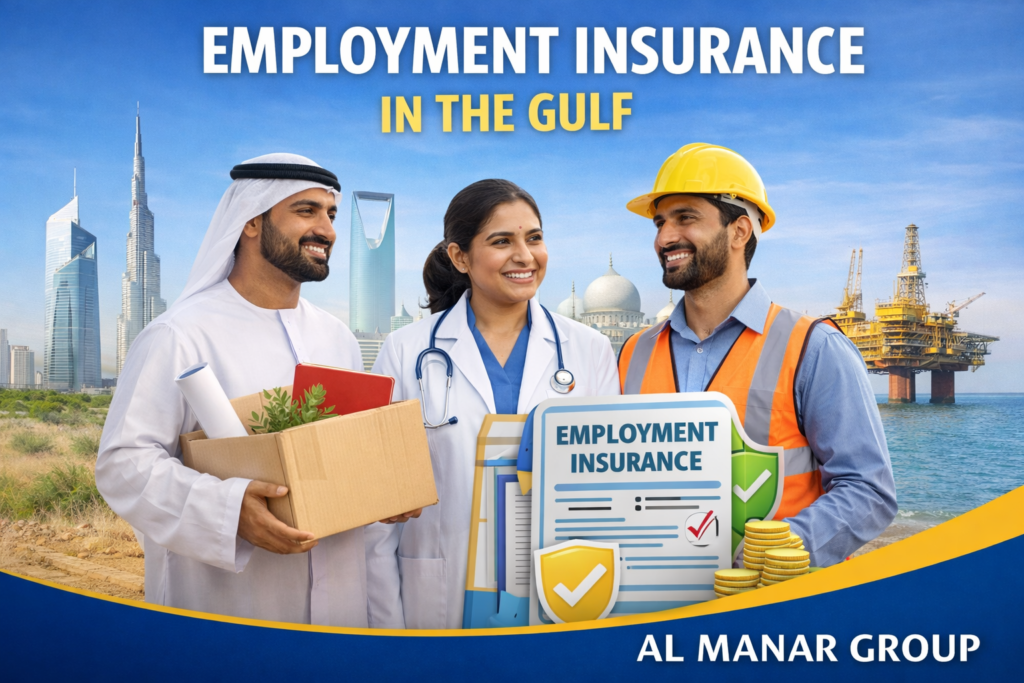
Employment insurance is becoming an increasingly important topic for workers in Gulf Cooperation Council (GCC) countries. As millions of expatriates work across the Gulf region, governments are introducing employment insurance systems to protect workers from sudden job loss, financial instability, and unexpected economic changes.
This detailed guide explains employment insurance in the Gulf, how it works, which countries offer it, who is eligible, what benefits it provides, and why it matters for both employees and employers. Whether you are a new expatriate or an experienced Gulf worker, understanding employment insurance can help you stay financially secure.
What Is Employment Insurance?
Employment insurance is a financial protection system designed to support workers if they lose their job involuntarily. It provides temporary income assistance while the worker searches for new employment. Unlike health insurance, which covers medical expenses, employment insurance focuses on income protection.
In the Gulf region, employment insurance is a relatively new concept, introduced to enhance worker welfare, economic stability, and labor market confidence.
Why Employment Insurance Is Important for Gulf Workers
Job security in the Gulf has traditionally depended heavily on employers. If a worker lost their job, they often had limited time to find new employment or leave the country. Employment insurance helps reduce this financial shock by offering short-term income support.
For expatriates, this support is especially valuable because they often have family obligations, loans, and relocation costs. Employment insurance provides peace of mind and allows workers to plan their next steps without immediate financial pressure.
Is Employment Insurance Mandatory in the Gulf?
Employment insurance rules differ across GCC countries. Some nations have already implemented mandatory employment insurance schemes, while others are still studying or developing policies.
The general trend across the Gulf shows a strong move toward mandatory or semi-mandatory employment insurance, especially in countries with large expatriate workforces.
GCC Countries and Employment Insurance Overview
The Gulf Cooperation Council includes:
- United Arab Emirates (UAE)
- Saudi Arabia
- Qatar
- Kuwait
- Oman
- Bahrain
Each country has its own approach to employment insurance, depending on labor laws, economic structure, and workforce composition.
Employment Insurance in the United Arab Emirates (UAE)
The UAE introduced a federal unemployment insurance scheme, also known as Involuntary Loss of Employment (ILOE) Insurance. This system applies to both Emirati nationals and expatriate workers in the private and public sectors.
The program provides temporary cash compensation to workers who lose their job due to reasons beyond their control, such as company downsizing or restructuring.
Key Features of UAE Employment Insurance
The insurance pays a monthly cash benefit for a limited period, usually up to three months. The benefit amount is based on a percentage of the worker’s basic salary, subject to a maximum cap.
Workers must have contributed to the insurance scheme for a minimum period to be eligible. Voluntary resignation, misconduct, or disciplinary termination are not covered.
This system has significantly improved job security and confidence among UAE workers.
Employment Insurance in Saudi Arabia
Saudi Arabia has employment support programs designed primarily for Saudi nationals, such as unemployment assistance and workforce development initiatives. While expatriates do not currently receive direct unemployment insurance benefits, labor reforms are gradually improving worker protections.
For expatriates, employment insurance is still linked more to contractual agreements and employer responsibilities. However, the government continues to modernize labor laws to create a more balanced employment environment.
Employment Insurance in Qatar
Qatar is gradually expanding worker protection mechanisms as part of its labor reforms. While there is no standalone employment insurance system for expatriates yet, the country has introduced improved labor contracts, wage protection systems, and end-of-service benefits.
Discussions around broader employment insurance frameworks are ongoing, especially to support long-term workforce sustainability.
Employment Insurance in Kuwait
Kuwait focuses primarily on social security and public employment protection for citizens. Expatriate workers depend mainly on contractual benefits, end-of-service gratuity, and employer compliance with labor laws.
Employment insurance for foreign workers is not yet widely implemented, but labor law reforms continue to enhance transparency and worker protection.
Employment Insurance in Oman
Oman has made progress in employment protection, particularly for Omani nationals, through social insurance systems. For expatriates, employment insurance remains limited, but the government is actively reviewing labor policies to ensure fair treatment and economic stability.
As Oman diversifies its economy, employment insurance concepts are expected to expand gradually.
Employment Insurance in Bahrain
Bahrain is one of the Gulf countries that has introduced unemployment support systems, particularly for nationals. Expatriates benefit mainly from labor law protections, notice periods, and end-of-service benefits.
Bahrain’s focus on workforce sustainability suggests that broader employment insurance models may be considered in the future.
Who Is Eligible for Employment Insurance in the Gulf?
Eligibility depends on the country and specific program. In general, workers must:
Be legally employed with a valid work permit
Have an active employment contract
Have contributed to the insurance scheme for a minimum period
Lose their job involuntarily
Workers dismissed due to misconduct, fraud, or voluntary resignation are usually not eligible.
What Does Employment Insurance Cover?
Employment insurance in the Gulf typically provides temporary financial assistance, not long-term support.
Coverage may include:
Monthly cash compensation
Income support for a limited duration
Assistance during job search period
The purpose is to help workers meet basic living expenses while transitioning to new employment.
What Employment Insurance Does Not Cover
Employment insurance does not cover:
Voluntary resignation
Termination due to disciplinary issues
End-of-service gratuity
Medical expenses
Permanent income replacement
It is designed as a short-term safety net, not a substitute for regular employment.
Difference Between Employment Insurance and End-of-Service Benefits
Many Gulf workers confuse employment insurance with end-of-service gratuity. These are two different benefits.
End-of-service benefits are paid by employers at the end of a contract based on years of service. Employment insurance, on the other hand, is a structured insurance system that provides temporary income after job loss.
Both benefits complement each other but serve different purposes.
Employer Responsibilities Regarding Employment Insurance
In countries where employment insurance is mandatory, employers must:
Register employees in the insurance scheme
Ensure contributions are paid on time
Inform employees about coverage details
Comply with labor and insurance regulations
Failure to comply can result in fines, legal penalties, or restrictions on business operations.
Employee Responsibilities in Employment Insurance
Employees also have responsibilities, including:
Registering for the insurance scheme if required
Paying their share of contributions (if applicable)
Keeping employment records updated
Submitting claims within the allowed timeframe
Understanding policy terms helps avoid claim rejection.
Cost of Employment Insurance in the Gulf
Employment insurance costs are generally affordable. Contributions are often shared between employees and employers or paid fully by employees at low monthly rates.
The goal is to keep insurance accessible while ensuring sustainability of the system.
How to Claim Employment Insurance Benefits
Claim procedures vary by country, but generally include:
Submitting a job loss notification
Providing employment and salary documents
Proof of involuntary termination
Meeting eligibility conditions
Claims are reviewed by relevant authorities before benefits are released.
Common Mistakes Workers Make About Employment Insurance
Many workers assume employment insurance covers all types of job loss, which is not true. Others fail to register on time or do not understand contribution requirements.
Some workers also confuse employment insurance with visa extensions, which are separate processes.
Being informed helps avoid disappointment during difficult times.
Employment Insurance and Expat Visa Status
Employment insurance does not automatically extend residency visas. However, financial support can help workers manage expenses while searching for a new sponsor or employer within legal timelines.
Workers should always check immigration rules alongside employment insurance benefits.
Benefits of Employment Insurance for Employers
Employment insurance benefits employers by:
Creating a stable labor market
Reducing worker anxiety
Enhancing company reputation
Supporting compliance with modern labor standards
A secure workforce is more productive and loyal.
Future of Employment Insurance in the Gulf
Gulf countries are continuously reforming labor laws to align with global standards. Employment insurance is expected to expand in coverage, digital access, and inclusivity.
As the region diversifies economically, employment insurance will play a key role in workforce resilience and social stability.
Why Employment Insurance Matters for Gulf Economies
Employment insurance supports economic balance by maintaining consumer spending during job transitions. It reduces financial stress, encourages fair employment practices, and strengthens trust between workers and employers.
For expatriate-driven economies, it is a crucial step toward sustainable growth.
Employment insurance in the Gulf is a growing and essential part of modern labor systems. While coverage and eligibility vary by country, the overall direction is clear: greater protection for workers and a more secure employment environment.
Every Gulf worker should understand employment insurance, their rights, and their responsibilities. Staying informed empowers workers to make better career decisions and ensures financial stability during uncertain times.